




How to Make Your Drums Sound Dirty and Dusty Like the 90s
If you have ever loaded a clean drum break into your DAW, hit play, and immediately thought "this sounds too modern", you already know the problem. Modern recordings are clean, wide and hyper-detailed. The drums on a Pete Rock, DJ Premier, RZA or early Alchemist record are the opposite: narrow, saturated, slightly broken, and somehow more alive because of it.
That sound is not an accident. It is the result of a very specific signal path that involves vintage samplers, magnetic tape, cassette dubs, and crate-dug vinyl. The good news is that you can get extremely close to it inside your DAW with the right plugins and the right order. This is the exact chain we use at Sample Packs by Soul Chemist when we cook drums for our packs, including Gorilla Breaks.
Why 90s Drums Sound the Way They Do
Before touching a plugin, it helps to understand what is actually happening on those classic records. Producers like Pete Rock, Large Professor, Q-Tip and DJ Premier were working with hardware samplers like the Akai S950, the E-MU SP1200 and the Akai MPC60. These machines had very low bit depth (12 bit was the standard) and aggressive anti-aliasing filters that softened the top end and added a specific kind of grit. The samples themselves came from vinyl, often dusty copies that already carried noise, crackle and pitch wobble.
On top of that, mixes were printed to tape. Two inch reel or cassette dubs added compression, harmonic saturation and that slight high frequency roll off that makes everything sit together. The "dust" people chase today is the sum of all those imperfections, not any single effect.
So when we recreate this sound in the box, we are not just adding distortion. We are layering several types of imperfection: bit reduction, sampler color, tape saturation and analogue movement.
The Philosophy of Dirty Drums
A common mistake is to slap a single saturator on the drum bus and call it done. That gives you distortion, not character. Real dirty drums have three qualities working together at the same time.
First, there is loss of high frequency information. Vintage samplers cut everything above 16 kHz, and tape does something similar in a more musical way. Second, there is harmonic content added in the low mids and midrange, which is where saturation and tape excitation live. Third, there is movement: wow, flutter, slight pitch instability and noise floor. Static distortion sounds harsh. Moving distortion sounds vintage.
Keep these three ideas in mind because every plugin in the chain below is solving one of them.
The Plugin Chain I Use Every Day
This is the chain that ends up on most of the drum breaks I release. The order matters, and I will explain why after listing the tools.
AIR Flavor Pro for Color and Punch

AIR Flavor Pro is the first thing I reach for because it adds the kind of front end saturation and lo-fi character that you would get from the input stage of an MPC combined with a beaten up VHS tape. It is not a transparent saturator. The Distortion, Vinyl and Volume modules push the transients forward and give the body of the kicks and snares a thick, slightly compressed quality, while the Digital and Pitch modules add the kind of micro instability that screams vintage. I use it conservatively, usually keeping each module subtle and letting the combination do the work. The goal here is character, not destruction.
D16 Decimort 2 for Bit Crushing Done Right

Most bitcrushers sound terrible because they are too clean about how they crush. Decimort 2 is different because it models the actual converters of vintage samplers like the SP1200 and the MPC60. The presets that emulate those machines are an instant time machine. I tend to use it on individual drum hits rather than the full bus, because applied to a full break it can become overwhelming. On a snare or a hat layer, a single instance of Decimort 2 can do more than five other plugins combined.
Inphonik RX950 and RX1200 for True Sampler Emulation
 This is where it gets serious. The RX950 emulates the Akai S950, the same converter chain that defined the sound of countless golden era records. The RX1200 emulates the SP1200. These plugins are doing real conversion: they downsample your audio, apply the original anti-aliasing filter, and bring it back up. The result is that unmistakable filtered, grainy top end that no EQ alone can recreate.

My workflow is to print drum hits through RX950 or RX1200 as if they were going through a real sampler. Pitching the sample down before loading it (and pitching it back up after) gives you the classic 12 bit crunch on the high end. This is the exact trick producers used in the 90s to stretch sampler memory, and it is responsible for half of the sounds you love.
Wavesfactory Cassette for Tape Realism

After the sampler stage, I want to add the layer that simulates someone having dubbed the beat to a cassette and played it back. Wavesfactory Cassette nails this. It has wow and flutter controls, tape type selection, and noise. I use the cheaper tape settings (Type I) with a touch of wow to introduce that slight pitch movement that makes everything feel less digital. A little goes a long way. If you can hear the cassette obviously, you have gone too far.
Master Bus: Waves Tape and Universal Audio Tape

On the master bus or the mix bus, I always print through some kind of tape emulation. My favourites are the Waves J37 (modeled on the Abbey Road tape machine that recorded most of The Beatles' catalogue) and the Universal Audio Studer A800. They do different things. The J37 has a warmer, more saturated character that flatters boom bap drums beautifully. The Studer is slightly cleaner but glues everything together with serious authority.
This stage is not about color, it is about cohesion. Tape on the master bus is the glue that makes the kick, snare and hats feel like they were recorded in the same room at the same time, even if they came from five different sources.
My Signal Chain Order
Order matters because each plugin reacts to what comes before it. Here is what I run, from first to last:
The chain starts with AIR Flavor Pro to set the front end character. Then Decimort 2 if I want extra bitcrush on specific elements. Then the sampler emulation step with RX950 or RX1200, which is the heaviest character move. After that, Wavesfactory Cassette for the analogue movement and noise floor. Finally, on the master, Waves J37 or UAD Studer A800 to glue the whole mix together.
You do not need every plugin on every drum. Sometimes a kick only needs AIR Flavor Pro and tape. Sometimes a snare needs the full chain. Use your ears. The mistake most producers make is applying every effect at full intensity. Subtlety is what separates dirty from broken.
Tips Beyond Plugins
There are a few non plugin techniques that make a huge difference and cost nothing.
Pitch your samples down before processing and back up after. This was the classic trick to fit more seconds into a 12 bit sampler, and it creates that characteristic aliased top end. Even doing this with just a pitch shifter and then reversing the process changes the texture significantly.
Sum your drum bus to mono and check how it sounds. Most 90s mixes had drums very narrow or fully mono. Wide stereo drums are a modern obsession. Tightening up the stereo image of your drums alone will make them sound more like the records you grew up listening to.
Cut the very top end with a gentle low pass. Most vintage samplers cut everything above 12 to 16 kHz. A subtle low pass around 14 kHz on your drum bus is one of the fastest tricks to age them.
Layer in a tiny amount of vinyl crackle and room noise. Not enough to be obvious, just enough to fill the silence between hits. The brain interprets that noise floor as "this is from a record".
Skip the Work: Try Gorilla Breaks
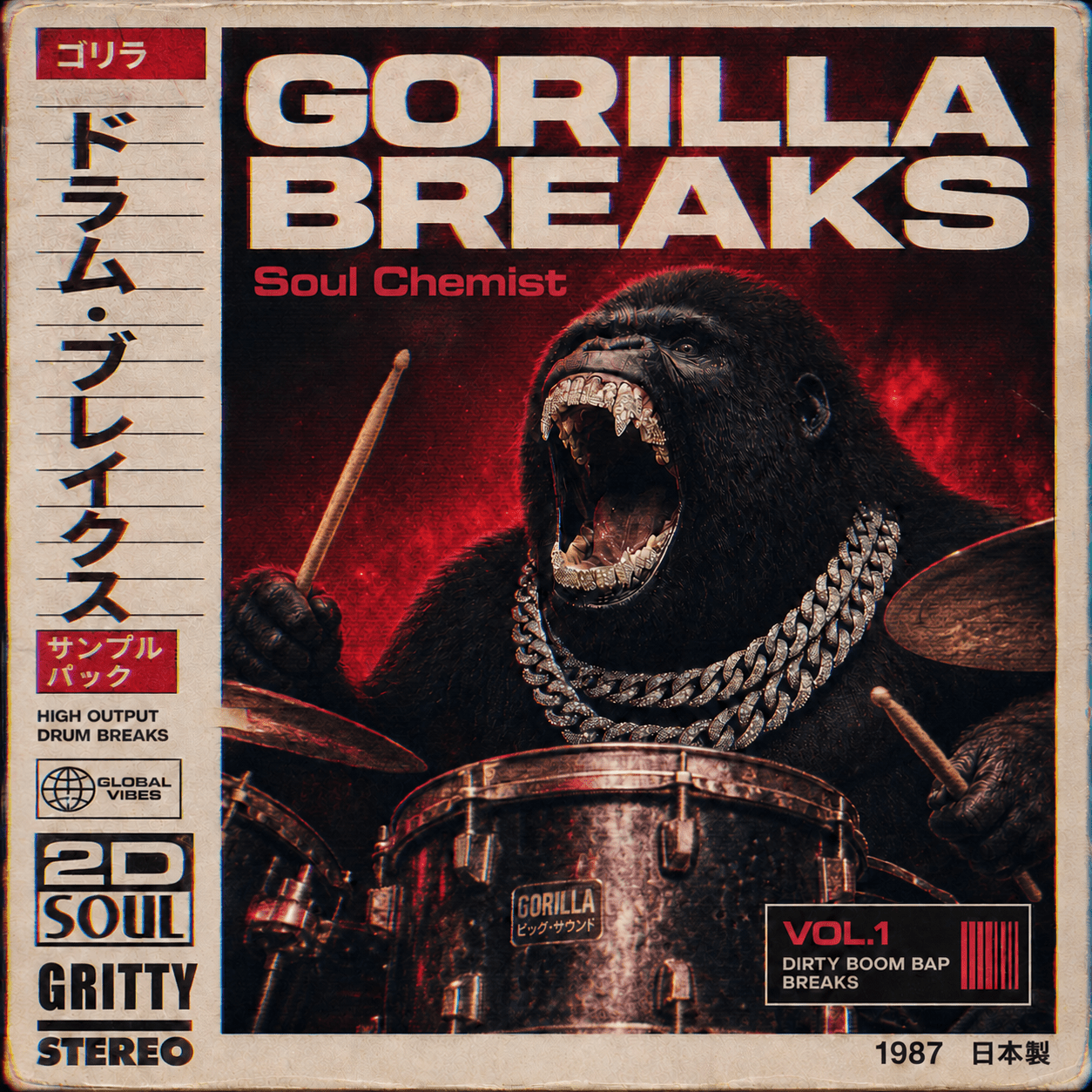
Everything I just described is what we do on every single break before it ends up in our packs. If you want drums that already come through this exact chain (samplers, tape, cassette, the whole process), check out Gorilla Breaks. It is a collection of boom bap drum breaks processed through the same vintage workflow, ready to drop into any beat with the dirt already baked in.
If you want to go even deeper, Gorilla Breaks Vol.2 expands the catalogue with new breaks, more variations and the same hand crafted processing. Both packs are designed for producers who want that classic Griselda, Alchemist or Roc Marciano drum aesthetic without spending hours on the chain.
Final Thoughts
Making drums sound dirty and dusty is not about destroying them. It is about layering imperfections that mirror what a record went through in 1994: vinyl, sampler, tape, cassette, mixdown. Get those four steps in your chain, keep every effect subtle, and your drums will start sitting in your beats the way the records you love sit in their mixes.
The plugins above (AIR Flavor Pro, Decimort 2, RX950, RX1200, Wavesfactory Cassette, Waves J37, UAD Studer A800) are the tools that get me there every time. Try them in this order, trust your ears, and remember that less is always more.
Now load a break and get dirty.


Share:
Tar Prayers MPC Expansion: Dark Boom Bap Guide | Soul Chemist
How to Sell Beats in 2026: The Honest Guide (From Someone Who Started Selling Without Following the Same Old Rules)