







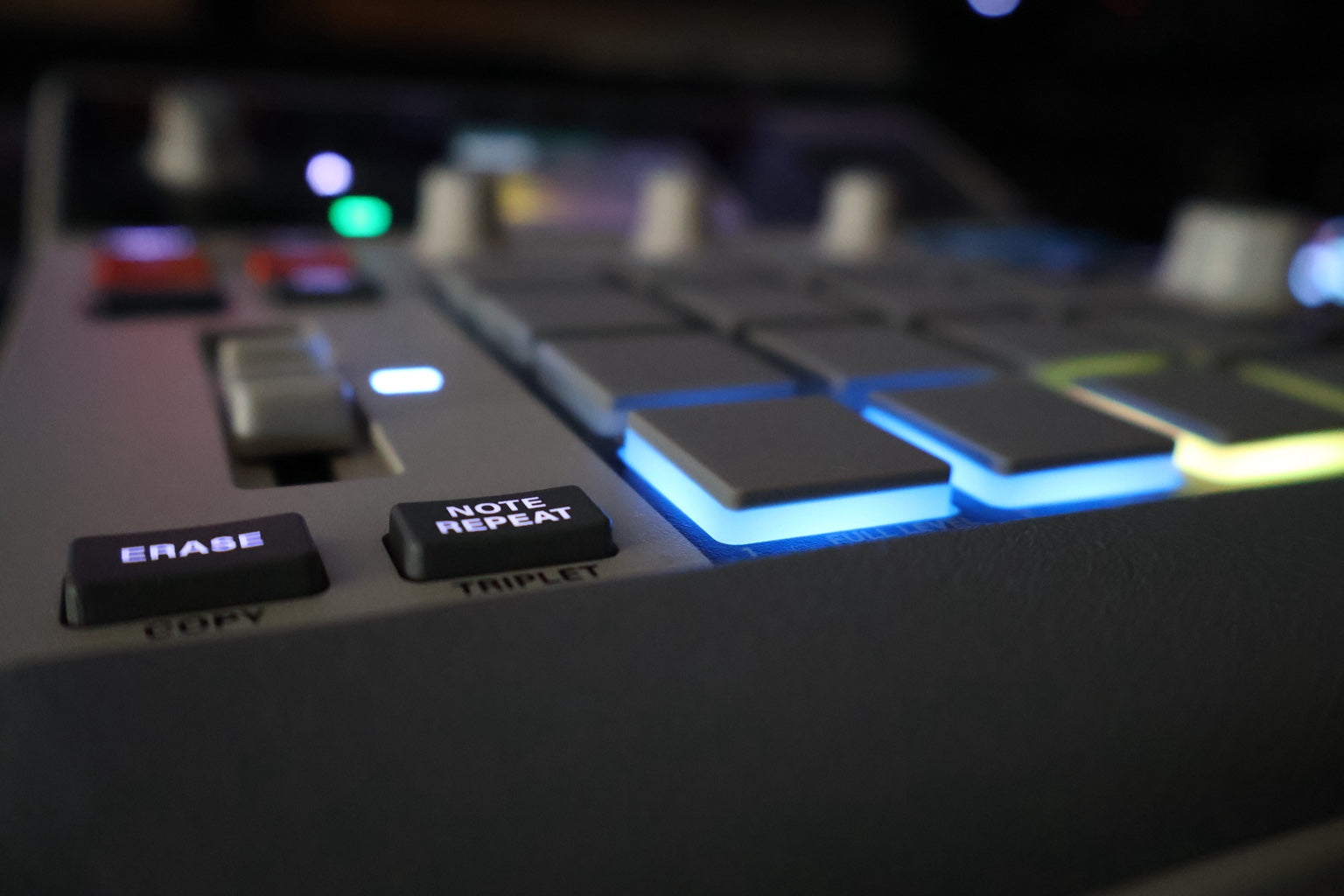
When Akai dropped the MPC Sample in March 2026, the internet lost its mind. Forums blew up. Stock sold out on day one. People were convinced the $399 price tag was fake. It wasn't.
After more than 12 years producing music on hardware — Akai S950, MPC 2500, MPC X SE, SP404, four-track tape — I've watched a lot of gear come and go. The MPC Sample is not just another compact gadget chasing the Teenage Engineering crowd. This thing is a serious tool with a clear purpose: get ideas out of your head and into the machine, fast, anywhere.
Here's my full breakdown.
What Is the Akai MPC Sample?
The Akai MPC Sample is a portable, battery-powered standalone sampler released on March 24, 2026, at $399 / £349 / €399. It draws its visual DNA directly from the MPC60 — the legendary 1988 Roger Linn-designed machine that defined the sound of hip hop — and packages a complete sampling and sequencing workflow into a unit you can fit in a backpack.
Dimensions: 23.6 × 19.4 × 5.0 cm. Battery life: up to five hours. Built-in 3-watt speaker. Internal microphone. 16 RGB velocity-sensitive pads with poly aftertouch. And direct project compatibility with MPC3 software.
This is not a toy. This is a scaled-down MPC, not a stripped-down one.
Akai MPC Sample Full Specs
| Feature | Specs |
|---|---|
| Price | $399 / £349 / €399 |
| Release date | March 24, 2026 |
| Pads | 16 RGB, velocity-sensitive, poly aftertouch |
| Polyphony | 32 stereo voices |
| Sound banks | 8 (A through H) |
| Factory kits | 106 included |
| Display | 2.4-inch full-colour LCD |
| Effects | 4 FX engines, 60 effect types |
| Battery | Rechargeable lithium-ion, up to 5 hours |
| Speaker | Built-in 3-watt |
| Microphone | Internal mic for on-the-spot sampling |
| Connectivity | Stereo 1/4" in/out, headphone out, MIDI in/out, sync out, USB-C |
| Storage | microSD reader |
| File support | WAV, MP3, AIFF, FLAC, OGG and more |
| Software | Full MPC3 project compatibility |
| Dimensions | 23.6 × 19.4 × 5.0 cm |
Design and Build: MPC60 Vibes in 2026
The first thing you notice is that it looks immediately like a vintage MPC. Akai finally had the sense to lean into that aesthetic after years of more modern, angular designs on the Live and One series. The MPC Sample is the most visually classic MPC Akai has released in decades.
The three real-time control knobs and the legacy MPC parameter fader — lifted directly from vintage MPC models — give it a tactile, hands-on feel that connects to the lineage. This is not accidental design. It's a deliberate callback to a culture.
The 2.4-inch full-colour LCD is small but functional. You get enough resolution for waveform editing and sample navigation without needing a full touchscreen. It's focused, not flashy.
Build quality for the price point feels solid. This is portable gear built for real use, not shelf display.
Sound and Performance: Where It Actually Matters
The Pads
The pads are the heart of any MPC, and the Sample gets this right. They are velocity and aftertouch sensitive — polyphonic aftertouch, which is significant at this price. When people talk about "MPC feel," they're describing the way the pads respond to how you play. These pads feel great. Triggering beats on them is immediate and musical.
They lack some of the advanced MPCe capabilities found on the top-end current MPCs, but at $399, they are brilliantly responsive and make beatmaking genuinely enjoyable.
Instant Sample Chop
The Instant Sample Chop mode is one of the standout workflow features. You load a sample, hit chop, and you're slicing in seconds. Combined with real-time Timestretch and Repitch, you have a fast, hands-on way to manipulate audio that doesn't require a screen or a mouse. This is how sampling should feel — immediate and physical.
For boom bap producers who work with loops, breaks, and vinyl-sourced material, this workflow is exactly right.
Effects: 4 Engines, 60 Types
Four effects engines with 60 effect types, accessible via Pad FX and Knob FX. Internal resampling with effects applied. You can record back into the machine with effects printed — a workflow that connects directly to how producers have used hardware like the SP404 for years.
For gritty, textured sound design — the kind of processing that gives boom bap records their character — this effects architecture gives you real room to work.
Connectivity: More Than You'd Expect
For a unit this size, the connectivity is genuinely impressive. Akai included stereo 1/4-inch inputs and outputs, a headphone output, MIDI in and out, sync out, and USB-C for power, MIDI, audio I/O, and file transfer.
MIDI in and out matters. It means you can connect external gear, sync to your studio setup, or integrate the MPC Sample into a larger hardware rig without hassle. The sync out adds even more flexibility for live or studio use.
The microSD reader for storage and the internal microphone round out a connectivity package that covers serious use cases, not just casual sketching.
MPC3 Integration: The Ecosystem Advantage
Here's where the MPC Sample separates itself from every other compact sampler in its price range. Projects created on the MPC Sample load directly into MPC3 software on Mac or PC. The April 2026 MPC 3.8 firmware update deepened this integration significantly, adding seamless workflow continuity between MPC hardware, desktop software, and the MPC Sample.
If you already work in the MPC ecosystem — MPC X, MPC Live, MPC One — this is your portable sketchpad that connects directly to your main workflow without any friction. Start a beat on the train. Open it on your MPC X when you get home. No conversion, no workarounds.
This is the MPC Sample's biggest competitive advantage over the Roland SP-404 MKII, the Teenage Engineering EP-133 K.O. II, and the Ableton Move. Nothing else in this price range drops natively into an existing professional production environment like this.
MPC Sample vs the Competition
Akai MPC Sample vs Roland SP-404 MKII
The SP-404 MKII is a proven tool with a massive user base and excellent lofi character. It edges out the MPC Sample on some sound design flexibility and has a more established community of tricks and techniques. But it doesn't connect to a full desktop production environment the way the MPC Sample does with MPC3. If you're already in the MPC world, the choice is clear.
Akai MPC Sample vs Teenage Engineering EP-133 K.O. II
The K.O. II is more playful and approachable. The MPC Sample is more serious, more connected to the MPC workflow lineage, and targets producers who already have a production practice. The MPC Sample wins on depth of sequencing, connectivity, and ecosystem integration.
Akai MPC Sample vs Ableton Move
The Move is the most DAW-integrated option, with strengths in transferring ideas to Ableton Live. The MPC Sample wins on hardware feel, pad quality, connectivity (MIDI in/out), and the built-in microphone and speaker. The Move is better for Ableton users; the MPC Sample is better for everyone else.
Akai MPC Sample vs Elektron Model:Samples
The Model:Samples brings Elektron's exceptional sequencer. If sequencing depth is your priority, the Elektron approach is different — and some would argue deeper. The MPC Sample brings better pads, internal monitoring, and MPC ecosystem integration. Different tools for different workflows.
What the MPC Sample Is Not
Honesty matters. The MPC Sample has real limitations.
No advanced automation or modulation. Compared to more expensive MPCs, you don't get deep automation lanes or LFO modulation per parameter. This is a deliberate choice to preserve immediacy, but it is a real ceiling.
The sequencer. Some users coming from Elektron or TR-style step sequencers will miss that style of programming. The MPC sequencer is more traditional and less steppy. Know what you're getting.
DAW project transfer is less seamless than the Move. Compared to Ableton Move's workflow for moving stems and projects to Live, the MPC Sample's process requires more manual steps. Akai has confirmed ongoing firmware support, so this may improve.
Audio glitches in FlexBeat during tempo changes. Known issue as of firmware 1.3. Akai is aware and working on it.
Who Is the MPC Sample For?
Existing MPC users looking for a sketchpad. This is the clearest use case. If you have an MPC X, MPC Live, or MPC One at home, the MPC Sample is a natural complement — a portable machine that shares your ecosystem and keeps you in the workflow you know.
Producers who work with samples and breaks. The Instant Sample Chop, Timestretch, and Repitch tools are built for this. If you're digging through crates and you want to chop on the fly, this machine was designed around exactly that.
Beat makers who work from breaks, loops, and vinyl-sourced material. The sonic approach — warm, hands-on, effects-driven sampling — aligns naturally with boom bap production values.
Entry points into the MPC ecosystem. For a new producer who wants real MPC workflow without the investment of an MPC X or Live, $399 is a genuinely accessible entry point that doesn't compromise the core experience.
The Sample Packs Question: What Sounds Work Best
If you're running the MPC Sample with third-party sample packs, the Instant Sample Chop mode and 32 voices of polyphony make it a strong performance machine for drum-based material.
For boom bap-oriented packs — raw drum breaks, vinyl-textured loops, gritty one-shots — the MPC Sample's character suits that material well. The effects engines add the kind of crunch and space that makes underground hip hop production sound right: lo-fi without being a gimmick.
The 8-bank system with 106 factory kits included means you can start making beats immediately out of the box, but bringing your own sound library via microSD is where the machine becomes yours.
Is the Akai MPC Sample Worth $399 in 2026?
Yes, with context.
If you're already inside the MPC ecosystem, it's almost a no-brainer as a second machine. The MPC3 integration alone justifies the investment for anyone who already works on a larger MPC unit.
If you're looking for your first piece of hardware and you want to enter the MPC world, $399 is the most accessible that entry has ever been, and you're not sacrificing the core of what makes an MPC an MPC: the pads, the sequencer, the sampling workflow.
If you're comparing it to a Roland SP-404 MKII or a Teenage Engineering K.O. II purely on standalone features, the decision is closer and depends on your specific workflow. But the MPC Sample's ecosystem integration is a differentiator that competitors simply cannot match.
The fact that it sold out on day one tells you everything about where the market is.
Final Verdict
Rating: 4.5 / 5
The Akai MPC Sample is the most important portable sampler Akai has ever made. It brings real MPC workflow to a battery-powered, backpack-sized format, connects natively to MPC3, and does it all at a price that makes hardware sampling accessible to a new generation of producers without alienating the veterans.
Its limitations are real — no deep modulation, sequencer depth below Elektron standards, firmware issues being addressed — but they are limitations of scope, not of quality. Within its scope, it delivers with confidence.
For boom bap producers, sample-based beatmakers, and anyone already inside the MPC ecosystem, this is one of the most sensible gear purchases of 2026.
Quick Reference: Akai MPC Sample Key Facts
- Price: $399 / £349 / €399
- Release date: March 24, 2026
- Battery life: Up to 5 hours
- Pads: 16 RGB, velocity + poly aftertouch
- Polyphony: 32 stereo voices
- Effects: 60 types across 4 engines
- Software integration: MPC3 (full project compatibility)
- Connectivity: Stereo 1/4" I/O, MIDI in/out, sync out, USB-C, microSD
- Main competitors: Roland SP-404 MKII, Teenage Engineering EP-133 K.O. II, Ableton Move
- Best for: Existing MPC users, boom bap producers, sample-based beatmakers
Looking for sample packs and drum kits optimized for hardware samplers and MPC workflow? Browse the full catalog at samplepacksbysoulchemist.com — raw breaks, vinyl-sourced drums, and boom bap textures built for machines like this one.



Share:
How to Sell Beats in 2026: The Honest Guide (From Someone Who Started Selling Without Following the Same Old Rules)
How to Make Boom Bap Drums: The Complete Guide