


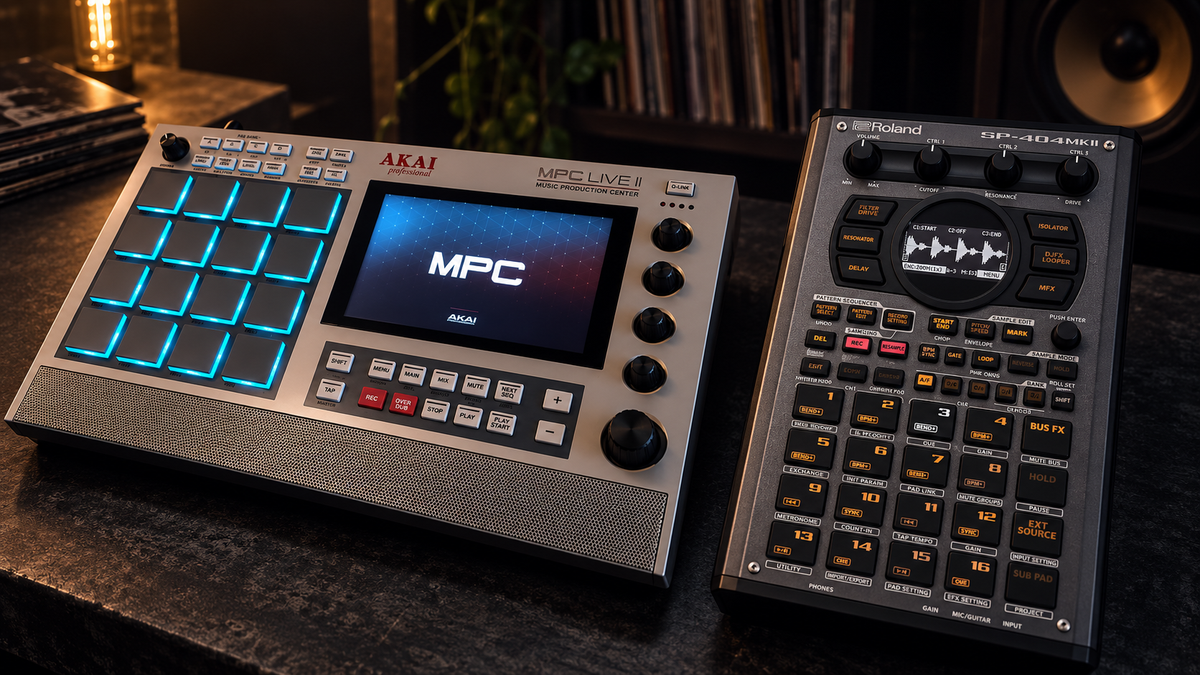
If you make boom bap, the MPC and the SP-404MKII are two of the most useful hardware workflows you can put in front of you. They can both sample, chop, sequence, resample, process drums, and build complete ideas. But they do not encourage you to work in the same way.
That difference matters more than any specification sheet.
The modern MPC is closer to a complete standalone production environment. It gives you deep sample editing, drum programs, plugin instruments, audio and MIDI tracks, a mixer, arrangement tools, expansion support, and a project structure designed to take a beat from the first chop to a finished arrangement.
The SP-404MKII is more immediate and deliberately narrower. It excels at sampling, resampling, destructive decisions, performance effects, quick pattern building, and turning a simple loop into something that feels played rather than assembled.
I use both types of workflow because they solve different problems. This guide is not about declaring one machine the winner. It is about deciding which one should sit at the center of your process.
The Short Answer
Choose an MPC if you want one machine to handle sampling, sequencing, drum programs, bass, plugins, mixing, arrangement, storage, and complete song construction.
Choose an SP-404MKII if you want a smaller, faster sampling and resampling instrument with excellent hands-on effects, a performance-oriented workflow, and fewer layers between an idea and the sound coming out of the machine.
Choose both if you want the MPC to organize and build the record, then use the SP-404MKII as a creative processor, resampling box, and performance instrument.
MPC vs SP-404MKII at a Glance
| Area | Modern MPC Workflow | SP-404MKII Workflow |
|---|---|---|
| Main philosophy | Complete standalone production system | Sampler, resampler, effects box, and performance instrument |
| Chopping | Deep waveform editing and program-based organization | Fast, tactile chopping with immediate resampling |
| Sequencing | Detailed tracks, sequences, arranger, MIDI, automation | Pattern-based sequencing, real-time recording, TR-REC |
| Effects | Deep routing, inserts, sends, submixes, plugins, master processing | Fast hands-on performance FX and resampling |
| Arrangement | Stronger for complete songs and large projects | Stronger for loops, patterns, resampling, and live manipulation |
| Sound library | Folders, programs, keygroups, expansions, WAV libraries | Samples and projects with direct pad-based access |
| Best fit | Producer who wants the whole record inside one system | Producer who values speed, resampling, FX, and physical interaction |
First, What Do We Mean by “MPC”?
This comparison refers to the modern Akai MPC standalone ecosystem, not legacy machines such as the MPC2000XL or MPC2500.
The current MPC family includes several models with different hardware specifications. The workflow, however, shares the same core idea: standalone sampling and sequencing with pads, touchscreen editing, programs, tracks, projects, effects, storage, and access to the MPC software environment.
Current models range from compact units to much more powerful systems. For example, Akai's current comparison guide lists the MPC One G2 with a Gen 2 eight-core CPU, 4 GB of RAM and 64 GB of storage, while the MPC Live III moves to 8 GB of RAM, 128 GB internal NVMe storage, MPCe expressive pads, a rechargeable battery, built-in speakers, and expanded audio capabilities.
The exact hardware changes, but the reason you choose an MPC remains similar: you want a production center, not only a sampler.
For current model specifications, see the official Akai MPC Series comparison guide.
The SP-404MKII Is a Different Kind of Machine
The SP-404MKII is built around direct sampling, pads, patterns, effects, and resampling.
Roland currently specifies 32-voice polyphony, 16 GB of internal storage, 2,560 samples and 2,560 patterns across 16 projects, 16 velocity-sensitive pads plus a sub pad, a 1-to-64-bar pattern sequencer, USB-C audio and MIDI, SD card backup and transfer, and Skip Back Sampling that can capture up to 40 seconds of recent output.
It also gives you a large effects section that is central to the experience rather than an extra page you visit at the end of the beat.
That is the important distinction. On the SP, sampling and processing often become the same action.
For the latest firmware and specifications, see the official Roland SP-404MKII page.
The Real Difference: Production System vs Creative Instrument
An MPC asks:
How do you want to build this record?
The SP-404MKII asks:
What happens if you sample this again?
That is an oversimplification, but it describes the creative pressure each machine puts on you.
The MPC rewards structure. You create programs, tracks, sequences, routings, arrangements, and reusable systems.
The SP rewards commitment. You sample, process, resample, print the effect, change the timing, and keep moving.
For boom bap, both philosophies are valuable.
1. Sampling and Chopping
MPC: better when you want control
The MPC is excellent when you want to see the sample clearly and make deliberate edits.
You can work with detailed waveforms, create slices, convert chops into programs, change start and end points, tune pads, adjust envelopes, build mute groups, and continue editing the program after the first pattern is already running.
This is especially useful when a sample contains many possible chop points and you want to create a reusable instrument from the source.
A typical MPC workflow might be:
- Load a complete sample.
- Find the main phrases.
- Create chops.
- Convert them into a program.
- Play several variations.
- Edit individual pads after hearing them in context.
- Build drums, bass, and arrangement around the final flip.
The process is deep without forcing you to print decisions too early.
SP-404MKII: better when you want immediacy
The SP feels more like manipulating recorded material than constructing a program.
You can sample directly to pads, chop the recording, change pitch, sequence it, apply effects, then resample the result onto another pad.
Skip Back Sampling is particularly useful because the SP is constantly capturing recent output. When you play something unexpectedly good, you can recover it instead of trying to reproduce it from memory.
This encourages a different kind of sampling. You are more likely to discover a version by performing and printing it rather than by endlessly adjusting the original source.
Which is better for boom bap chopping?
If you enjoy detailed chop preparation and want a program that remains editable, choose the MPC.
If you enjoy finding the idea by touching the sample, processing it, and committing quickly, choose the SP.
2. Drum Programming and Pocket
MPC: stronger as a drum programming system
The MPC gives you a deeper environment for building drum programs.
You can organize multiple kits, tune individual pads, control envelopes, velocity response, mute groups, filters, effects, routing, timing, swing, and automation while keeping the whole kit inside a structured program.
That matters when drums are central to your production identity.
It is also exactly why an MPC expansion can feel different from a normal WAV folder. A properly built expansion can arrive with kits already mapped and balanced, giving you a playable system instead of a directory of loose sounds.
Read What Is an MPC Expansion and How Does It Work? for a deeper explanation of programs, XPN files, standalone folders, and expansion structure.
SP-404MKII: stronger when the drums become part of the resample
The SP gives you real-time pattern recording and TR-REC step sequencing, but the most interesting drum workflow often happens when you stop treating the sequence as permanent.
Build a pattern. Run it through an effect. Resample it. Chop the resampled version. Layer another kick. Remove a hat. Print the result again.
The groove gradually becomes audio rather than a list of events.
This can be extremely effective for dirty boom bap because small timing and processing differences become embedded in the sound.
The practical difference
The MPC is better when you want to edit the groove.
The SP is better when you want to perform the groove into a new piece of audio.
3. Effects and Sound Character
SP-404MKII: effects are part of the instrument
The SP-404 line became iconic partly because producers use its effects while performing, not only during final mixing.
On the MKII, effects can become part of the rhythm. You can filter a sample during a transition, compress the drums, introduce lo-fi texture, manipulate pitch, add delay, or resample a complete phrase through several stages of treatment.
The important advantage is speed. Effects are close to the pads and designed to be touched.
This makes the SP especially good when you want the beat to develop through repeated processing.
MPC: deeper routing and repeatability
The MPC is more like a complete mixer and production environment.
You can process at pad level, program level, submix level, send level, and master level. You can build repeatable routing and save it with the project.
That is ideal when you want to know exactly where the character comes from and preserve the system for the next session.
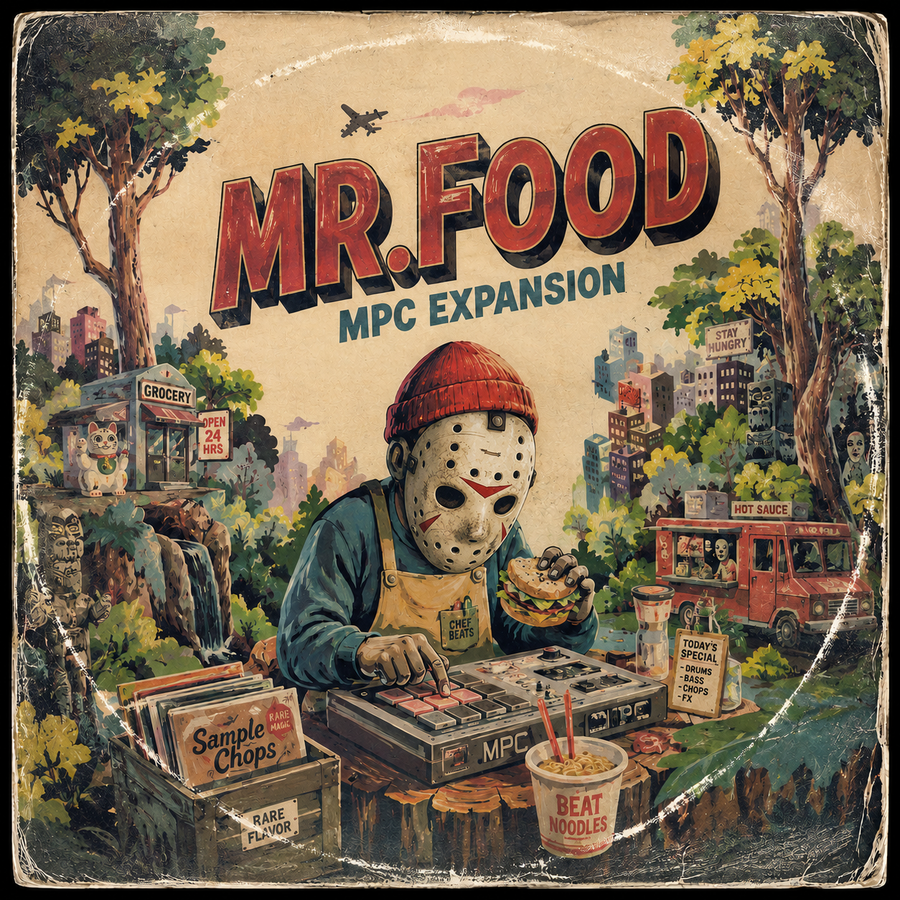
For example, the MR.FOOD MPC Expansion is built around this philosophy. Its 30 kits combine mapped drums, samples, basses, textures, and FX inside a ready-to-load MPC environment rather than giving you only loose folders. The product currently includes 544 sample chops and is designed to move from loading to beatmaking with less setup.
That fits the current Soul Chemist direction: LOAD. PLAY. CREATE.
4. Arrangement and Finishing Beats
MPC: the stronger choice for full arrangements
This is one of the clearest differences.
Modern MPC systems are designed to carry a project much further than a basic loop. MPC 3 adds a more linear arrangement environment on supported hardware, alongside sequences, audio tracks, plugin tracks, automation, mixing, and export.
If your normal session becomes an intro, verse, hook, second verse, breakdown, and outro, the MPC gives you a more direct path to building that structure without leaving the machine.
SP-404MKII: better when the arrangement is performance
The SP can absolutely build complete patterns and songs, but many producers get more from it by treating arrangement as performance.
Mute elements. Trigger patterns. Change effects. Resample sections. Record a longer performance into another device or DAW.
This can create arrangements that feel less grid-based because transitions happen in real time.
Which is better?
If you want precise recall and detailed song construction, MPC.
If you want the final form to emerge from a performance, SP-404MKII.
5. Bass, Instruments, and Complete Production
This is where the MPC creates a much larger gap.
Current standalone MPCs can run instrument plugins, keygroups, audio tracks, MIDI gear, and complete drum programs inside the same project. The exact limits depend on the model. Akai's current Gen 2 systems expand those capabilities significantly, with models such as the Live III supporting up to 32 plugin tracks in standalone according to Akai's current comparison documentation.
The SP-404MKII now includes a Sound Generator for creating simple tones and sampled bass material, but it is still not trying to become the same kind of instrument workstation.
If you regularly build basslines, use plugin instruments, sequence external synths, or construct large projects entirely without a computer, the MPC is the more natural center.
If your production is primarily samples, drums, resampling, and effects, the SP may be all you need.
6. Working With a Large Sound Library
MPC
The MPC is better suited to a large organized library because it supports folders, programs, keygroups, expansions, removable storage, and a browser designed around a complete production collection.
This makes it a strong platform when you have thousands of drums and samples and want them structured for repeated use.
SP-404MKII
The SP stores samples directly across pads, banks, and projects. Roland currently specifies up to 2,560 samples across 16 projects in internal storage, with SD card support for backup, restore, import, and export.
That is plenty for a lot of work, but the philosophy is different. The SP is better when you curate what enters the machine rather than expecting it to behave like a giant master library.
For a library that needs to work across both machines, universal WAV files are the safest common layer.
The All Packs Library is built around that idea, with more than 80,000 WAV samples and more than 80 GB of drums, one shots, melodic material, breaks, textures, and FX. WAV content can move between the MPC, SP-404, and DAW without depending on one hardware format.
Read How to Organize Your Sample Library for MPC and DAW Production if your collection is already becoming difficult to navigate.
7. Portability and Live Use
SP-404MKII
The SP is extremely easy to put in a small setup. Roland lists it at approximately 1.1 kg, and it can run from its AC adapter, compatible USB-C bus power, or six AA batteries.
That makes it practical for live beat sets, sampling outside the studio, small desktop setups, processing another sampler, and performing effects over a stereo mix.
MPC
Portability depends heavily on the model.
The MPC Live family is explicitly designed for mobile standalone production and includes a rechargeable battery. The current Live III also includes built-in speakers and a microphone. Units such as the One G2 offer a compact standalone workstation but do not include battery power.
So there is no single answer to “Is the MPC portable?” You need to choose the right MPC model for that job.
8. Learning Curve
The SP looks simpler because there are fewer layers, but that does not necessarily mean it is easier.
A lot of its depth lives in shortcuts, button combinations, sampling habits, and the logic of resampling. The current Roland support page for the SP-404MKII includes a dedicated shortcut reference for a reason.
The MPC has more visible structure. There are more pages, modes, tracks, programs, and routing options, but the touchscreen makes many functions easier to discover visually.
The learning curves are different:
MPC: more concepts to learn, but more explicit structure.
SP-404MKII: fewer production layers, but more muscle memory and workflow-specific shortcuts.
9. Which One Is Better for Dirty Boom Bap?
Neither machine automatically makes your beat dirty.
That comes from the source, timing, pitch, resampling, saturation, filtering, compression, clipping, and arrangement.
The SP makes destructive processing and resampling extremely natural, so it can push you toward a rougher finished texture faster.
The MPC makes it easier to build a complete dirty production system with separate control over each layer.
If you want to understand the processing side in more detail, read How to Process Drum Breaks Without Killing the Groove.
10. The Hybrid Workflow: MPC + SP-404MKII
This is where the comparison becomes more interesting.
You do not have to choose one philosophy.
Workflow A: Build in the MPC, process in the SP
- Load or build the drum program in the MPC.
- Chop the main sample.
- Create the bass and basic arrangement.
- Send selected drums, samples, or the stereo beat into the SP-404MKII.
- Process the audio with SP effects.
- Resample the processed version.
- Return the result to the MPC or record it into the final arrangement.
This gives you MPC structure with SP commitment.
Workflow B: Discover in the SP, finish in the MPC
- Sample records or WAV files into the SP.
- Experiment with pitch, effects, chops, and resampling.
- Print the strongest phrases as new samples.
- Move those WAV files into the MPC.
- Build a structured drum program, bassline, and complete arrangement around them.
This lets the SP generate accidents while the MPC turns the best accident into a finished record.
Workflow C: One shared WAV library
Keep your core drums, breaks, and samples in universal WAV format.
Use the same source library in both systems. Only convert the sounds into MPC programs or SP projects when a session needs them.
This is why the distinction between source library and machine-specific workflow matters.
11. Where MPC Expansions Fit
An MPC expansion is most valuable when the MPC is your main environment.
The expansion can arrive with programs, pad mapping, browser artwork, standalone organization, and an XPN installer. You load a kit and start playing rather than building the entire system first.
This is a major advantage over the SP because the SP does not use the MPC expansion format.
If you own both machines, the raw WAV files become the bridge. Current Soul Chemist MPC releases can include the XPN, prepared standalone content, and original WAV files, depending on the individual product.
That means you can load the finished programs on the MPC while still using the original audio in the SP-404MKII or another sampler.
See the File Compatibility guide for the exact difference between sample packs, drum products, and current MPC expansion formats.
12. A Real Example: MR.FOOD
MR.FOOD represents the direction where an MPC becomes more than a folder browser.
The expansion contains 30 ready-to-load kits and 544 chops, with drums, samples, bass, textures, and FX organized around complete playable ideas. Instead of stopping at raw WAV delivery, the point is to reduce setup and put the material directly under the pads.
That is the central advantage of the MPC side of this comparison.
On the SP-404MKII, I would approach the same source material differently. I would use the WAV files, place only the sounds I want on the pads, then build character through resampling and effects rather than through a pre-built expansion program.
Neither is more authentic. They simply move the work to a different part of the process.
Who Should Buy an MPC?
- I want to finish complete beats without opening a computer.
- I want detailed control over my chops and drum programs.
- I use bass instruments, plugins, MIDI, or external hardware.
- I want a structured mixer and arrangement environment.
- I have a large sound library.
- I want to use complete MPC expansions.
- I prefer keeping decisions editable for longer.
Who Should Buy an SP-404MKII?
- I want sampling and resampling to be the center of the process.
- I love manipulating effects in real time.
- I prefer a smaller and more immediate hardware setup.
- I work mainly with audio rather than plugin instruments.
- I like committing to sounds instead of keeping every parameter editable.
- I want a strong live performance and effects machine.
- I already use a DAW or another sampler for detailed arrangement.
Who Should Own Both?
You will get the most from owning both if you already understand why you need each one.
Do not buy two samplers because you think more hardware will automatically produce better beats.
Own both when the MPC is your production center, the SP is your resampling and FX instrument, you regularly move audio between machines, and you deliberately want two different decision-making environments.
Frequently Asked Questions
Is an MPC better than an SP-404MKII?
It is more complete as a standalone production system, but that does not make it better for every producer. The SP-404MKII is faster and more focused for sampling, resampling, effects, and performance.
Which is better for boom bap?
Both. Choose the MPC for structured sample-based production and full arrangements. Choose the SP for resampling, effects, performance, and a more immediate audio-first process.
Which is easier for chopping samples?
The MPC gives you deeper visual editing and program organization. The SP gives you a faster tactile process and makes resampling part of chopping. Your preferred method matters more than the number of editing functions.
Can the SP-404MKII replace an MPC?
Yes, if your workflow does not require the MPC's deeper arrangement, plugin, routing, expansion, and track-based features. For a producer centered on samples and effects, the SP can be the main machine.
Can an MPC replace an SP-404MKII?
Functionally, the MPC can sample, process, sequence, and resample. But it does not recreate the exact physical workflow that makes the SP attractive. The value of the SP is the way its effects and resampling encourage decisions.
Can I use Soul Chemist samples on both?
Yes, when the product includes standard WAV files. WAV sample packs, drum kits, and breaks can be loaded into both compatible MPC systems and the SP-404MKII. MPC-specific XPN and standalone program files are for the MPC ecosystem.
Can I use MR.FOOD on the SP-404MKII?
The MPC expansion programs are designed for compatible MPC hardware and software. The original WAV content can be used in other WAV-compatible samplers when included with the product. Always check the individual product page for the exact supplied formats.
Which machine is better without a computer?
The MPC is the more complete computer-free studio because it combines sampling with deeper sequencing, arrangement, plugins, routing, and project management. The SP is more focused but can still create complete sample-based productions without a computer.
Which is better live?
The SP-404MKII is particularly strong for live performance because of its compact size, pad workflow, effects, pattern triggering, and flexible power options. MPC models can also perform live, but their strength is broader production functionality.
Final Verdict
The MPC and SP-404MKII are not competing versions of the same idea.
The MPC is a production system.
The SP-404MKII is a sampling and resampling instrument.
If you want to load sounds, build programs, sequence drums, create bass, arrange the song, mix the project, and keep everything inside one environment, start with the MPC.
If you want to grab audio, manipulate it, print effects, resample your mistakes, perform patterns, and discover the record through physical interaction, start with the SP.
If you already know both workflows, use the MPC for structure and the SP for destruction.
The important question is not which machine has more features. It is which machine removes more friction between the idea in your head and the beat coming out of the speakers.
LOAD. PLAY. CREATE.
Explore Soul Chemist MPC Expansions for complete ready-to-load MPC workflows, use the Sample Packs collection when you want universal WAV material for either machine, or enter the All Packs Library when you want one large source archive for MPC, SP-404, and DAW production.

Share:
How to Process Drum Breaks Without Killing the Groove
7 Sample Chopping Techniques Every Hip Hop Producer Should Know